Belt-Drive vs Direct-Drive Turntables: Which Is Better for Your Vinyl?

Australia’s vinyl revival has encouraged a new generation of listeners to rediscover the pleasure of putting on a record, lowering the stylus and settling into a complete album. Naturally, many buyers begin searching for the best turntables Australia has to offer.
Then comes the crucial question: should you choose a belt-drive or direct-drive turntable?
The honest answer is that neither system is universally better. A beautifully engineered belt-drive deck can outperform a poorly designed direct-drive model, and a refined direct-drive turntable can deliver outstanding high-fidelity performance.
The right choice depends on how you listen, how your system is built and what you expect from the experience.
The short answer
Choose a belt-drive turntable if your priority is focused home listening, low motor coupling, an audiophile design philosophy and a calm, refined presentation.
Choose a direct-drive turntable if you value fast start-up, high torque, pitch control, ruggedness and freedom from periodic belt replacement.
For many music lovers building a traditional two-channel system, belt drive remains the natural starting point. For listeners who want maximum speed control, operational convenience or DJ-style handling, direct drive may be the more suitable foundation.
The key word is engineering.
How the two drive systems work
A belt-drive turntable places the motor away from the platter. A flexible belt connects the motor pulley to the platter, transferring rotational energy while also acting as a mechanical filter.
That separation can reduce the transmission of motor vibration, cogging and electrical noise into the platter, bearing, cartridge and tonearm. In simple terms, the motor does its work at a distance.
A direct-drive turntable takes a different approach. The motor is integrated with the platter spindle, or coupled directly to it. The platter itself becomes part of the motor system.
This creates significant advantages in torque and speed recovery. It also means that motor forces, servo correction and bearing noise are physically closer to the cartridge and tonearm.
Neither approach is automatically silent or superior. The quality of the motor, bearing, platter, plinth and isolation feet matters enormously.
1. Speed stability, wow and flutter
Speed stability determines whether music sounds steady and natural. If the platter rotates too quickly or slowly, sustained piano notes, vocals and strings can develop an audible wavering effect.
This is measured using wow and flutter:
- Wow refers to slower variations in pitch.
- Flutter refers to faster variations.
- A lower wow and flutter figure generally indicates more stable rotational speed.
Direct drive has a theoretical advantage when the stylus encounters resistance. The motor can respond quickly and maintain speed, especially when the design incorporates a sophisticated servo control system.
Belt drive can also provide excellent speed stability. A heavy platter, accurate motor, quality belt and well-machined bearing can produce a remarkably consistent rotation. The belt’s elasticity may help smooth small motor irregularities.
Be careful when comparing published specifications. Manufacturers use different test methods, including weighted RMS, unweighted and peak measurements. The figures are not always directly comparable.
The practical conclusion is simple: do not choose a turntable based on its drive label or wow and flutter figure alone. Listen to the complete deck.
2. Motor isolation and the noise floor
Vinyl playback involves extremely delicate signals. The cartridge is reading movements in a record groove measured on a microscopic scale. Any unwanted vibration can become part of the signal.
This is why motor isolation matters.
A belt-drive motor is physically separated from the platter and tonearm. The belt acts as a buffer, helping to reduce motor-borne vibration and contributing to a quiet noise floor.
However, belt drive is not automatically silent. A poorly isolated or noisy motor can still transfer vibration through the belt, chassis or support surface. Bearing rumble and acoustic feedback can also compromise performance.
Direct-drive designs have their own strengths. A properly engineered direct-drive motor can be exceptionally quiet, with carefully controlled electronics, shielding, damping and a rigid chassis. The motor’s proximity is not a problem when the entire structure has been designed around it.
The best result depends on the relationship between:
- Motor quality and control.
- Bearing tolerances.
- Platter damping.
- Plinth stiffness.
- Isolation feet.
- Speaker placement.
- Room acoustics.
The turntable is one part of a larger mechanical system. It needs a stable, level and well-isolated home.
3. Torque and start-up time
This is where direct drive wins decisively.
A direct-drive turntable typically reaches operating speed almost immediately. It also resists platter drag and recovers quickly when the platter is slowed by hand pressure.
That makes direct drive ideal for:
- DJ mixing.
- Scratching and back-cueing.
- Pitch adjustment.
- Frequent starts and stops.
- Broadcast and professional use.
The direct-drive tradition is closely associated with DJ and broadcast equipment. Brands such as Marantz and Denon also have long histories in turntable design, while the wider direct-drive heritage is strongly linked to professional-use decks.
A belt-drive turntable generally starts more gently. It may take a second or two to reach its correct speed, and it is not designed for scratching or braking the platter by hand.
For ordinary listening, this is rarely a disadvantage. You press start, wait briefly and then enjoy the record. The gentler mechanical connection can be part of the design’s appeal.
4. Platter mass and resonance
The platter is more than a surface for placing a record. It is an important part of the turntable’s foundation.
A heavier platter has greater inertia. In plain English, it is harder to disturb, helping the motor maintain a smooth and even rotation. It can also help resist small changes caused by stylus drag.
But mass alone does not guarantee quality. A heavy platter with a poor bearing can create more problems than it solves. Materials, damping and the accuracy of the spindle are equally important.
Resonance is another consideration. When unwanted energy reflects through the platter, plinth or tonearm, it can colour the sound. Some designs use layered plinths, elastomer damping, acrylic, metal or carefully selected woods to control these vibrations.
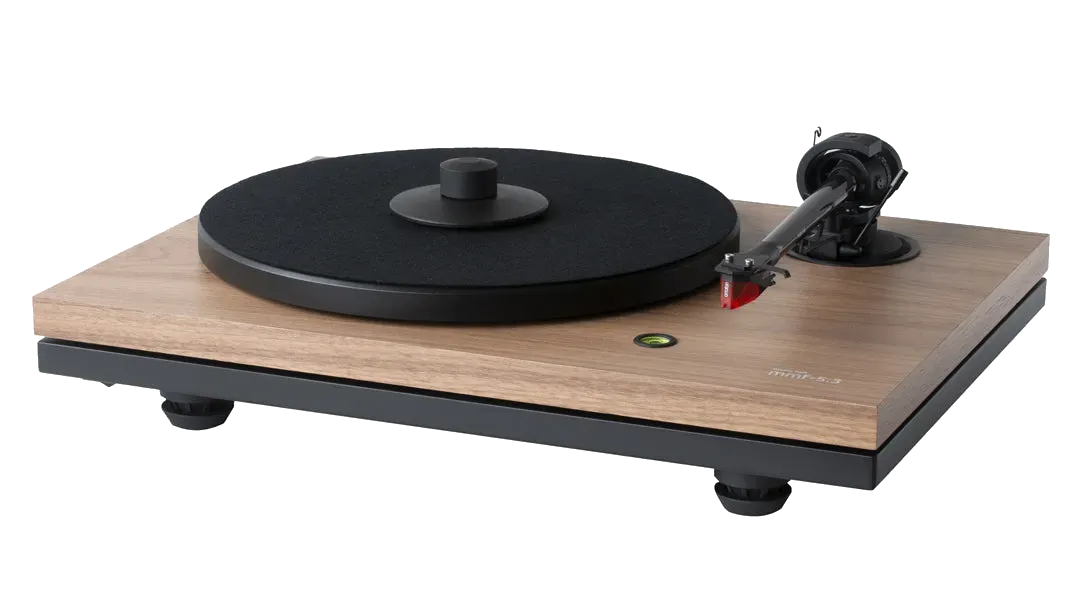
Music Hall’s belt-drive range illustrates this design philosophy. Models such as the Music Hall mmf-5.3 SE Walnut use a dual-plinth construction, a carbon-fibre tonearm and a real walnut veneer finish. The result is not merely attractive furniture. It is an attempt to create a quieter, more stable mechanical platform for the cartridge.
5. Tonearm and motor coupling
The tonearm must allow the cartridge to trace the groove accurately without being disturbed by the rest of the turntable.
On a belt-drive deck, the motor is usually positioned away from the tonearm and platter bearing. This can reduce mechanical coupling and simplify the path between the groove and the cartridge.
On a direct-drive deck, the motor is closer to the tonearm by design. This places greater demands on the motor control, bearing, platter damping and chassis construction.
Again, this is not a criticism of direct drive. It is simply a different engineering challenge.
A great turntable brings the motor, platter, tonearm and cartridge into balance. A modest turntable may have an impressive specification yet sound less convincing because the components are not working together as a coherent whole.
6. Maintenance, belts and bearings
Belt drive has one obvious consumable: the belt.
Over time, a belt may stretch, harden or collect dust and oil. Replacement intervals depend on belt quality, usage and storage, but replacing one every few years is a sensible practical expectation for many designs.
Changing a belt is normally straightforward. Keep the belt path clean, avoid touching it with oily fingers and follow the manufacturer’s instructions.
Direct drive eliminates the belt, which is convenient. However, it still relies on a motor, servo electronics, bearing and control circuitry. If a fault occurs, servicing may be more specialised.
Both types benefit from the same basic care:
- Keep the turntable level.
- Protect it from dust and direct sunlight.
- Clean records before playback.
- Set tracking force and anti-skate correctly.
- Follow the manufacturer’s instructions for bearing lubrication.
- Keep speakers and subwoofers away from the turntable where possible.
The maintenance difference is real, but it should not be the only reason you choose one design over the other.
7. The system matters more than the label
A turntable is an invisible backbone for your vinyl system. Its character is shaped by the phono stage, amplifier, speakers, room and support beneath it.
A belt-drive Music Hall may suit a listener who wants an inviting, tactile system for weekend albums and longer listening sessions. A direct-drive deck may suit someone who wants quick operation, multiple speeds or a more robust interface.
Your phono stage also matters. A quality unit such as the Primare R35 MM/MC phono preamplifier can provide the gain, loading flexibility and low-noise foundation needed to let a capable cartridge perform properly.
For a warm, intimate system, a belt-drive turntable paired with the compact, valve-era-inspired engineering of Sparkler Audio can create a particularly engaging listening experience. The aim is not to make every component sound the same. It is to create a coherent system that feels natural in your room.
You might instead pair a direct-drive deck with a Marantz integrated amplifier or a modern Denon system for a flexible setup combining vinyl, streaming and television audio.
Australian price guide
Turntable pricing in Australia is broad, and drive type does not provide a simple price shortcut.
At the accessible end, current examples include belt-drive models around $450 to $1,100 AUD, such as the Music Hall US 1 and Music Hall Classic. More advanced belt-drive decks commonly sit between $1,500 and $5,500 AUD, depending on the tonearm, cartridge, plinth and construction.
Direct-drive options range from affordable automatic models to high-end audiophile and professional designs. A capable direct-drive hi-fi turntable may sit around $2,000 to $5,000 AUD, while DJ-oriented models can be priced lower.
Remember to budget for the complete system. Cartridge upgrades, a phono stage, isolation support and proper setup can have as much impact as the drive mechanism itself.
So, which is better for your vinyl?
Use this decision framework:
Choose belt drive if you:
- Primarily listen at home.
- Prefer a focused audiophile design.
- Value motor isolation and low mechanical coupling.
- Enjoy a slower, more deliberate listening ritual.
- Want to explore cartridge and tonearm upgrades.
- Are comfortable replacing a belt periodically.
Choose direct drive if you:
- Want immediate start-up and strong torque.
- Need pitch control or variable speed.
- Value robust, convenient operation.
- Plan to DJ, back-cue or handle the platter frequently.
- Prefer not to replace belts.
- Have found a direct-drive model with excellent motor control and isolation.
For most listeners, the best choice is the turntable that makes them want to play another record.
Hear both approaches at Toma Audio
Specifications are useful. Listening is decisive.
Bring your own record to the Toma Audio showroom in Tweed Heads and hear a belt-drive Music Hall and a direct-drive deck side by side in our dedicated two-channel room. Use the same amplifier, phono stage and speakers, then listen for the qualities that matter to you: pitch stability, background quietness, bass control, vocal texture and the sense of musical ease.
Our Music Hall range is available to audition, alongside carefully matched amplification, phono stages and speakers. We can also help you compare a straightforward system with a more bespoke analogue setup.
There is no pressure to choose the most expensive option. We listen first, understand your room and your records, then help you find a sound investment that fits your life.
Contact Toma Audio to arrange a listening session, or email sales@toma.com.au. Bring the record you know best. We will let the music make the case.